

New test to crack down on steroid cheats
A test for anabolic steroids that could help to crack down on drug cheats in sport has been developed.
The research is reported in the latest issue of the Royal Society of Chemistry journal The Analyst.
Recent positive steroid tests in the worlds of cycling and athletics have brought the issue of cheating in sport back to the very top of the agenda.
Banned steroids such as nandralone continue to be used by athletes to boost their muscle mass. Linford Christie is one of the most high profile examples of an athlete who has tested positive for nandralone.
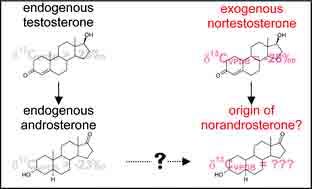
Analysing urine samples for a form of norandrosterone - a metabolite of nandralone - can uncover evidence of abuse.
But traces of the metabolite also occur naturally in the body, and current tests cannot determine whether the norandrosterone is naturally occurring or has been taken from an external source.
However, Moritz Hebestreit and colleagues from the German Sport University, Cologne, in collaboration with a researcher from the Montreal Anti-doping Laboratory, have developed a technique that can distinguish between the two.
This could help resolve cases where athletes have elevated levels of norandrosterone in their urine but insist they have never taken steroids.
Hebestreit's test differentiates between synthetic and natural norandrosterone by analysing the different amounts of two types of carbon (called isotopes) in the samples - using a technique called "gas chromatography combustion isotope mass spectrometry."
The artificial norandrosterone contains lower levels of carbon 13 (13C) compared to carbon 12, because it is produced from a plant source with less 13C than comes from normal dietary sources.
Thus a person whose norandrosterone contains this lower level of 13C has taken in an external source of nandralone.
The test can detect concentrations of norandrosterone as low 2ng (0.000000002g) per ml of urine - the level currently allowed by the World Anti-Doping Agency.
Tony Moffat, head of the Centre for Pharmaceutical Analysis at the University of London, said: "This excellent method is suitable for use in anti-doping programmes."
Hebestreit and his team now hope to extend the technique to discover the origins of other drugs by studying isotopes of other elements, such as Nitrogen and Hydrogen.
with thanks to Nicola Burton for the original article, and to Celia Clarke for providing it in advance.
Press office
- Tel:
- +44 (0) 20 7440 3351
- Email:
- Send us an email