Select Resource Type
All
(104)
Chemistry Resources for Classic Chemistry Experiments
Information & data
Snippets & articles
Educational resources & tests
Lesson plans & topics
Training & curricula
1 -
30 of
104 Resources
Sort By
Results Per Page
Page
of
4
Page
of
4
Hydrocarbons produce carbon dioxide and water when they burn. In this experimentthe products...
Audience:
TeacherStudent
Subjects:
Teaching chemistry, Teaching...
Age Group:
11 to 16 years
In this experiment, electricity and some indicators are used to make coloured writing.
Audience:
TeacherStudent
Subjects:
Teaching chemistry, Teaching...
Age Group:
11 to 16 years
Metal crystals can be grown using several methods - eg displacing one metal by another from a...
Audience:
TeacherStudent
Subjects:
Practical investigations, Laboratory...
Age Group:
14 to 18 years
In this experiment, ammonia is produced and collected. The gas is tested and the solubility...
Audience:
TeacherStudent
Subjects:
Teaching chemistry, Teaching...
Age Group:
14 to 18 years
When materials are added together, they may acquire new properties. When a solid and a liquid...
Audience:
TeacherStudent
Subjects:
Teaching chemistry, Teaching...
Age Group:
11 to 16 years
In an electrolysis experiment, the ions migrate towards electrodes of opposite charge.
In the...
Audience:
TeacherStudent
Subjects:
Teaching chemistry, Teaching...
Age Group:
11 to 18 years
In this experiment hydrogen is burnt with some air. The aim of the experiment is to find out...
Audience:
TeacherStudent
Subjects:
Teaching chemistry, Teaching...
Age Group:
11 to 16 years
This is an experiment named after René Descartes (1596–1650). Descartes was a French...
Audience:
TeacherStudent
Subjects:
Teaching chemistry, Teaching...
Age Group:
7 to 16 years
This experiment involves producing copper from copper ore (malachite). Thecomposition of...
Audience:
TeacherStudent
Subjects:
Everyday life applications:...
Age Group:
11 to 16 years
This experiment illustrates how much of the air is used in the rusting process. It is the...
Audience:
TeacherStudent
Subjects:
Teaching chemistry, Teaching...
Age Group:
7 to 16 years
Microbes are responsible for the production of some foods, for example cheese and yoghurt....
Audience:
TeacherStudent
Subjects:
Agricultural applications, Everyday life...
Age Group:
11 to 16 years
This experiment examines how a stable foam is produced and what reactions are involved.
Audience:
TeacherStudent
Subjects:
Everyday life applications: cooking & food...
Age Group:
11 to 16 years
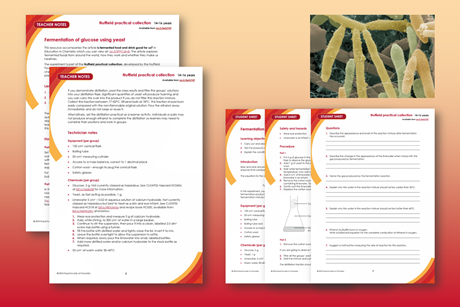
Beer and wine are produced by the fermentation of glucose by yeast. In this experiment, a...
Audience:
TeacherStudent
Subjects:
Agricultural applications, Everyday life...
Age Group:
14 to 18 years
Many areas of chemistry involve careful measurement. One example is measuring the change in...
Audience:
TeacherStudent
Subjects:
Analysis: quantitative, Relative masses,...
Age Group:
11 to 16 years
The aim of this experiment is first to make some glass and secondly to make some coloured...
Audience:
TeacherStudent
Subjects:
Everyday life applications:...
Age Group:
11 to 16 years
Rusting of iron and steel is a commonly occurring process with which we are all familiar....
Audience:
TeacherStudent
Subjects:
Teaching chemistry, Teaching...
Age Group:
11 to 16 years
A mixture of iron and sulfur can easily be separated. This is because there are no
chemical...
Audience:
TeacherStudent
Subjects:
Teaching chemistry, Teaching...
Age Group:
11 to 16 years
The combustion of alcohol produces energy. This experiment compares the amount of
heat...
Audience:
TeacherStudent
Subjects:
Teaching chemistry, Teaching...
Age Group:
11 to 18 years
One mole of any gas occupies the same volume when measured under the same conditions of...
Audience:
TeacherStudent
Subjects:
Standard laboratory procedures, Relative...
Age Group:
14 to 18 years
In this experiment, the water of crystallisation is removed from hydrated copper(II)
sulfate....
Audience:
TeacherStudent
Subjects:
Relative masses, masses & moles, Formulae,...
Age Group:
11 to 18 years
Producting fertilisers is very important. This experiment involves preparing ammonium...
Audience:
TeacherStudent
Subjects:
Formulae, Agricultural applications,...
Age Group:
11 to 18 years
The Group 7 elements are called the halogens. This experiment involves some reactions of the...
Audience:
TeacherStudent
Subjects:
Teaching chemistry, Teaching...
Age Group:
14 to 18 years
In this experiment the speed of a reaction is measured. Various metals in solution are
tested...
Audience:
TeacherStudent
Subjects:
Teaching chemistry, Teaching...
Age Group:
11 to 18 years
Some metals are more reactive than others. In this experiment, a strip of metal is added
to a...
Audience:
TeacherStudent
Subjects:
Teaching chemistry, Teaching...
Age Group:
11 to 18 years
In this experiment the pH of various oxides is tested.
Audience:
TeacherStudent
Subjects:
Teaching chemistry, Teaching...
Age Group:
14 to 18 years
Indigestion is caused by excess acid in the stomach. The tablets neutralise some of this...
Audience:
TeacherStudent
Subjects:
Titrimetric/volumetric analysis, Medical...
Age Group:
7 to 16 years
Alkenes (carbon compounds containing double bonds) undergo addition reactions. In
this...
Audience:
TeacherStudent
Subjects:
Teaching chemistry, Teaching...
Age Group:
11 to 18 years
It is often necessary to obtain a pure chemical from an impure sample. This experiment...
Audience:
TeacherStudent
Subjects:
Teaching chemistry, Teaching...
Age Group:
11 to 18 years
Water expands when it freezes. Most liquids contract when they freeze so this property of...
Audience:
TeacherStudent
Subjects:
Teaching chemistry, Teaching...
Age Group:
11 to 16 years
Diffusion occurs in liquids but more slowly than in gases. The particles are not as free to...
Audience:
TeacherStudent
Subjects:
Teaching chemistry, Teaching...
Age Group:
11 to 16 years
1 -
30 of
104 Resources
Sort By
Results Per Page
Page
of
4
Page
of
4