
Journal of Analytical Atomic Spectrometry
Innovative research on the fundamental theory and application of spectrometric techniques.
Chair: Heidi Goenaga-Infante
Open Access: Hybrid
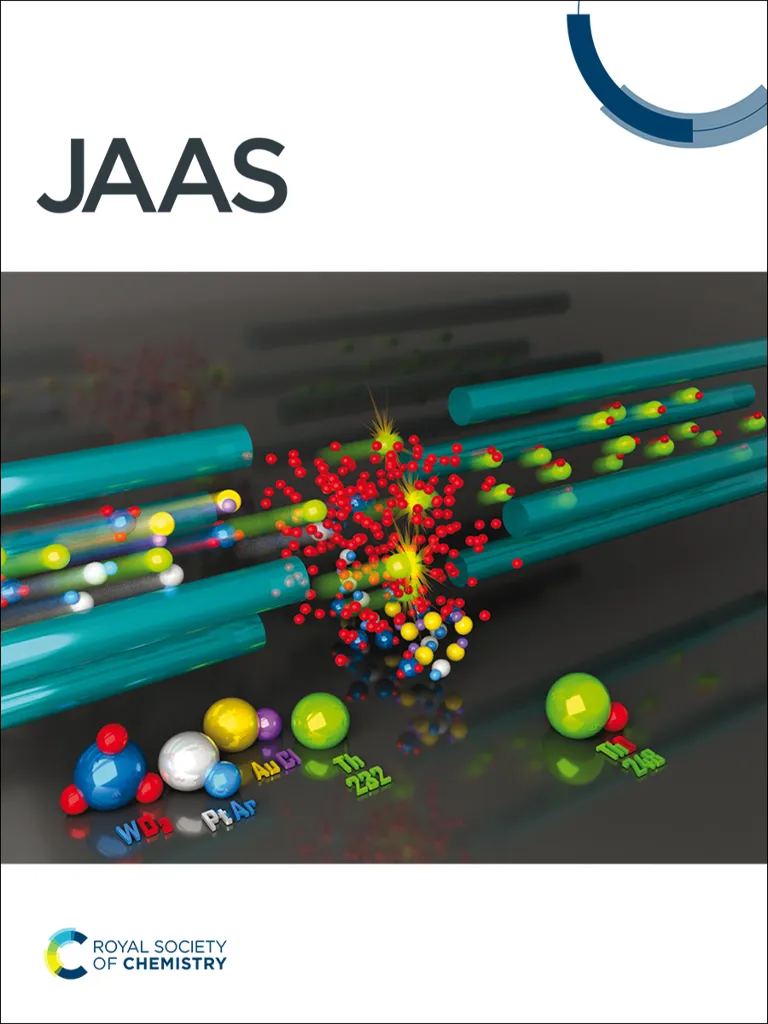
The Journal of Analytical Atomic Spectrometry (JAAS) is the central journal for publishing innovative research on fundamentals, instrumentation, and methods in the determination, speciation and isotopic analysis of (trace) elements within all fields of application. This includes, but is not restricted to, the most recent progress, developments and achievements in all forms of atomic and elemental detection, isotope ratio determination, molecular analysis, plasma-based analysis and X-ray techniques.
ISSN: 1364-5544
Indexed in: Scopus, Web of Science
Journal Impact factor
3.1 (2024)
First decision time (all)
38 days
First decision time (peer reviewed)
42 days
Scope
The journal welcomes full papers, communications, technical notes, critical and tutorial review articles, editorials, and comments, in addition to the Atomic Spectrometry Updates (ASU) literature reviews that are prepared by an expert panel.
Submissions are welcome in the following areas, but note this list reflects the current scope and authors are strongly encouraged to contact the Editorial team if they believe that their work offers potentially new and emerging research relevant to the journal remit.
All contributions are judged on originality and quality of scientific content, and appropriateness of length to content of new science.
Fundamental studies in the following:
- New and existing sources for atomic emission, absorption, fluorescence and mass spectrometry and those that provide both atomic and molecular information
- Sample introduction techniques for solids, liquids, gases
- Improvements in sensitivity, selectivity, precision, accuracy and/or robustness
- Isotope ratio measurements, including techniques for improving precision and mass bias correction
- Single channel and multichannel simultaneous detection systems
- Chemometrics, statistics, calibration techniques and internal standardisation
- Theoretical and numerical modelling of fundamental processes related to all of the above methodologies
Novel or improved methodologies in areas of application including, but not limited to the following:
- Biosciences, including elemental, speciation and isotopic analysis in biological systems, immunoassays based on metal-labeled antibodies, bio-imaging, and nanoparticle toxicology
- Geochemistry
- Environmental science
- Materials science, including engineered nanoparticles and quantum dots
- Metrology, including reference materials
- Forensic analysis
- Food and agricultural sciences
- Energy
- Archaeometry
- Molecular sources for elemental and isotopic analysis
- Atomic sources for molecular analysis
- Atomic and molecular techniques simultaneously used for complementary chemical information
Readership
The readership spans researchers in universities and related academic institutes, government and research organisations, industry, independent laboratories and consulting firms. The readership is cross-disciplinary and includes the following fields.
- Atomic spectrometry
- Mass spectrometry
- Biomedical and clinical science
- Pharmaceutical analysis
- Geochemistry and environmental science
- Toxicology
- Materials and nanoanalysis
- Forensics and archaeometry
Information for authors
Want to publish in this journal? Our author guidelines explain how to prepare and submit your article and provide useful information on the review and publication process including transfers, revisions and any article processing charges (APCs) that may apply.
You can read our payments and funding information for further details about APCs, which may apply for publishing open access in this journal, as well available discounts and waivers.
You may be able to publish open access in this journal, with no APC to pay, if your institution has an open access agreement with us. You can use our journal finder tool to check for agreements between us and your institution.
Meet the team


Xiandeng Hou
Sichuan University


Christine Vanhoof
Editorial board member
Flemish Institute for Technological Research (VITO
View profile

Maite Aramendia Marzo
University of Zaragoza
Marco Aurelio Zezzi Arruda
UNICAMP
Ramon Barnes
University Research Institute for Analytical Chemistry
Carole Bresson
French Alternative Energies and Atomic Energy Commission
José Broekaert
University of Hamburg
Ewa Bulska
University of Warsaw
David Clases
University of Graz
Marta Costas-Rodríguez
Universida de Vigo
George Donati
Wake Forest University
Fabio Duarte
Universidade Federal de Santa Maria
Carsten Engelhard
University of Siegen
Jörg Feldmann
University of Graz
Gabor Galbacs
University of Szeged
Marco Grotti
University of Genoa
Alexander Gundlach-Graham
Iowa State University
Detlef Günther
ETH Zürich
Wei Hang
Xiamen University
Gary Hieftje
Indiana University
Steve Hill
University of Plymouth
Takafumi Hirata
The University of Tokyo
Zhaochu Hu
China University of Geosciences
Johanna Irrgeher
Montanuniversitaet Leoben
Norbert Jakubowski
BAM
Gunda Koellensperger
University of Vienna
Kerstin Leopold
University of Ulm
Lara Lobo
University of Oviedo
Yi Lv
Sichuan University
Dmitriy Malinovskiy
LGC
Benjamin T. Manard
Oak Ridge National Laboratory
R Kenneth Marcus
Clemson University
Érico Marlon Moraes Flores
Universidade Federal de Santa Maria
Magdalena Matczuk
Warsaw University of Technology
Vincent Motto-Ros
Claude Bernard University Lyon 1
Sohail Mushtaq
University of Bristol
John Olesik
Ohio State University
Christophe Pecheyran
University of Pau and Pays de l'Adour
Spiros Pergantis
University of Crete
Jorge Pisonero
University of Oviedo
C. Derrick Quarles
Elemental Scientific
Steven Ray
State University of New York at Buffalo
Martín Resano
University of Zaragoza
Martin Šala
National Institute of Chemistry
Raquel Sánchez
University of Alicante
Jacob Shelley
Rensselaer Polytechnic Institute
Patricia Smichowski
National Atomic Energy Commission
Ralph Sturgeon
National Research Council
Joanna Szpunar
CNRS EP 132
Thibaut Van Acker
Ghent University
Lu Yang
National Research Council Canada
J R Bacon
University of Strathclyde
N Barlow
Sandwell General Hospital
S Branch
Herbalife
O Butler
Health & Safety Laboratory Buxton
W R L Cairns
Institute for the Dynamics of Environmental Processes of the Italian CNR
S Carter
INEOS
M R Cave
British Geological Survey
O Cavoura
University of West Attica
R Clough
University of Plymouth
J M Cook
British Geological Survey
A Cross
Reading Scientific Service Limited (RSSL
C M Davidson
University of Strathclyde
L Ebdon
H Evans
University of Plymouth
A Fisher
University of Plymouth
U Fittschen
Technical University of Clausthal
M Foulkes
University of Plymouth
B Gibson
Intertek Sunbury
C Harrington
SAS Trace Element Laboratory
S Hill
LGC
S J Hill
University of Plymouth
Y Madrid
Universidad Complutense de Madrid
R Mertz-Kraus
Johannes Gutenberg University Mainz
M Patriarca
Istituto Superiore di Sanita
J Pisonero
University of Oviedo
A Robson
Manchester University NHS Foundation Trust
B Russell
National Physical Laboratory
M Sargent
LGC
A Taylor
Royal Surrey County Hospital
R Taylor
University of Southampton
J F Tyson
University of Massachusetts
C Vanhoof
Flemish Institute for Technological Research (VITO
L Vincze
Ghent University
M White
Health & Safety Laboratory
Philippa Ross
Executive Editor
Alice Smallwood
Deputy Editor
David Lake
Development Editor
Gabriel Clarke
Development Editor
Rebecca Garton
Editorial Manager
Derya Kara-Fisher
Publishing Editor
Emma Stephen
Publishing Editor
Charlie Palmer
Publishing Editor
Tabitha Jay
Publishing Editor
Darryl Wilks
Editorial Assistant
Andrea Whiteside
Publishing Assistant
Sam Keltie
Publisher
Read this journal

Paper
TrCSL: A Transferred CNN-SE-LSTM Model for High-accuracy Quantitative Analysis of Laser-induced Breakdown Spectroscopy with Small Samples
Paper
Simultaneous determination of Cl, Br and I by aerosol-assisted PVG-ICP-MS
Paper
Determination of the uptake of lanthanide doped-carbon dots by human cells using single cell ICP-ToF-MS
Technical note
Nitrogen MICAP with post-plasma ionization mass spectrometry for elemental fluorine quantitation
More from this journal
Contact the journal team
We're here to help. Contact the journal team if you have any questions about publishing your paper with us.
Sign up for journal email alerts
Get table of contents alerts and notifications about calls for papers, themed issues and more.