

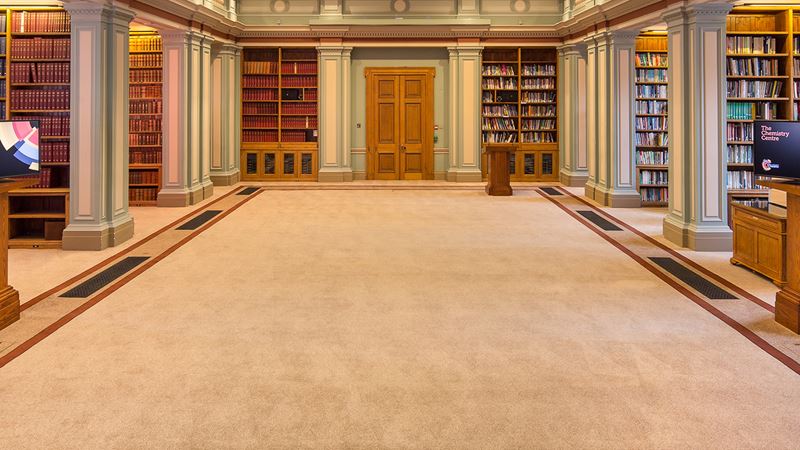

Walk-in access to the Main Library and Computer Room is available to Royal Society of Chemistry Members during the times stated below:
Library calendar
| Main Library | Computer Room | Staff Availability | |
| Monday 9 June | Closed | 9:00 to 5:00 | Contact Us |
| Tuesday 10 June | 9:00 to 5:00 | 9:00 to 5:00 | Contact Us |
| Wednesday 11 June | 9:00 to 3:00 | 9:00 to 5:00 | 10:30 to 3:30 |
| Thursday 12 June | 9:00 to 5:00 | 9:00 to 5:00 | Contact Us |
| Friday 13 June | Closed | 9:00 to 5:00 | Contact Us |
| Main Library | Computer Room | Staff Availability | |
| Monday 16 June | 9:00 to 5:00 | 9:00 to 5:00 | Contact Us |
| Tuesday 17 June | Closed | 9:00 to 5:00 | Contact Us |
| Wednesday 18 June | 9:00 to 12:00 | 9:00 to 5:00 | Contact Us |
| Thursday 19 June | 9:00 to 5:00 | 9:00 to 5:00 | Contact Us |
| Friday 20 June | 9:00 to 5:00 | 9:00 to 5:00 | Contact Us |
In addition to access to the collections we provide the following:
- Free wi-fi: Please ask at Reception for details
- Free tea, coffee, and water: Available from the waiting area next to Reception
- Book loans: Please refer to the Library catalogue for details
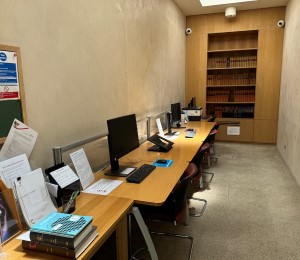
- Computer Room: A space for work and study, including access to two desktop computers for viewing information on the chemical sciences
- Copying and printing: A photocopier/printer is available outside the Computer Room (fair usage applies)
Discover what the Library collections have to offer or start using the Library catalogue now to browse the collections or find a particular item.
Our collections consist of the virtual (accessible via our Virtual Library) and the physical. The physical collections are comprised of loanable books, journals and reference items. The Historical Collection is available both physically, in Burlington House, and online, through our Historical Collection.
Library catalogue
The services provided by the Library are mostly only for members of the Royal Society of Chemistry but if you are not a member, we may still be able to assist so please ask.
As well as providing access to the collections (physically and virtually), we can undertake a range of enquiries.
Historical Enquiries
One of our most widely accessible enquiry services is the historical enquiry service.
As more people are keen to research their family history, they sometimes come across information to suggest that an ancestor was a past member of the Chemical Society or Institute of Chemistry; if this proves to be true, we can often provide some information.
Not limited to genealogy, we can also help with a wide range of biographical enquiries of scientists and more general history of the chemical sciences.
The Royal Society of Chemistry's Library Catalogue can be used to search for information on individual chemists and other scientists.
Technical Enquiries
Whilst unable to provide a detailed or technical search for information, we have many resources available to assist you. The main resources can be found in the Virtual Library, or you could search the Library catalogue or the RSC Publishing Platform.
We would also recommend looking through the Directory of Consultants to locate someone with the expertise to help you.
The Digital Collection (formerly, the Virtual Library) provides members with free access to a range of chemical resources from several different publishers.
To access
- Click the 'Digital Collection sign-in' button below
- Enter your Membership ID and Password and click 'Log In'
- Scroll down the page a little and click the 'Insight and Information' button (second from the left)
- Click 'Find out more' in the Digital Collection tab
Problems logging in?
- Access via the sign-in button only
- Enter your username as your 6 digit RSC number. If you have forgotten your ID or password, you can reset them on the Members' area sign-in page
- Clear the cookies from your browsers’ cache
- Try using a different browser
- ScienceDirect requires a separate account that you can request from the Library (accounts expire at the end of each year)
EBSCO eBooks
Access to over 100 titles on the chemical sciences, including many on the history of chemistry, and more than 3,000 general interest titles.
Kirk-Othmer Encyclopedia of Chemical Technology
Features over 1,300 regularly updated articles on chemical substances: their properties, manufacturing, and uses.
Also includes information on industrial processes and unit operations in chemical engineering, as well as fundamentals and scientific subjects related to the field. Environmental and health issues concerning chemical technology are also addressed.
ScienceDirect eJournals
18 journal archives (c. 1995 to 2016). Titles include Analytica Chimica Acta, Journal of Chromatography A and Tetrahedron Letters.
Springer eJournals and eBooks
Access to over 400 eBooks and the journal archives of over 100 titles, e.g. Analytical and Bioanalytical Chemistry; Applied Microbiology and Biotechnology; Physical and Engineering Sciences in Medicine.
Ullmann's Encyclopedia of Industrial Chemistry
Complete coverage of the science and technology in all areas of industrial chemistry containing over 1,000 major articles by some 3,000 authors.
The Presidents of the Chemical Society and the Royal Society of Chemistry (1841-2024)
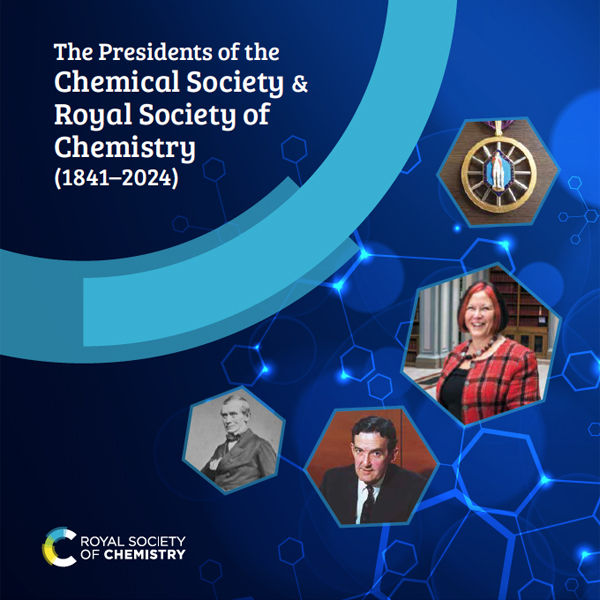 This booklet contains profiles on every president of the Chemical Society and the Royal Society of Chemistry since 1841.
Find out about some of their many professional achievements as well as other interesting facts about them; which president played in the second ever FA Cup Final? Who was the inspiration for the White Knight in ‘Alice Through the Looking Glass’? Who are the presidents that have craters on the Moon named after them?
Download the President's BookletThe Story of Burlington House
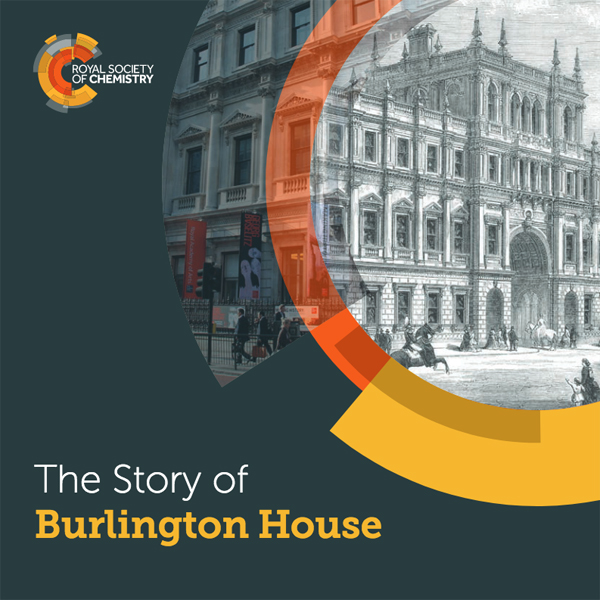 For a century and a half, the London premises of the Society have been within Burlington House in Piccadilly. Prior to it being the home of six learned societies, Burlington House was a private residence; this booklet charts the history of the building from 1664 to present day.
Pro Patria: Remembering the First World War
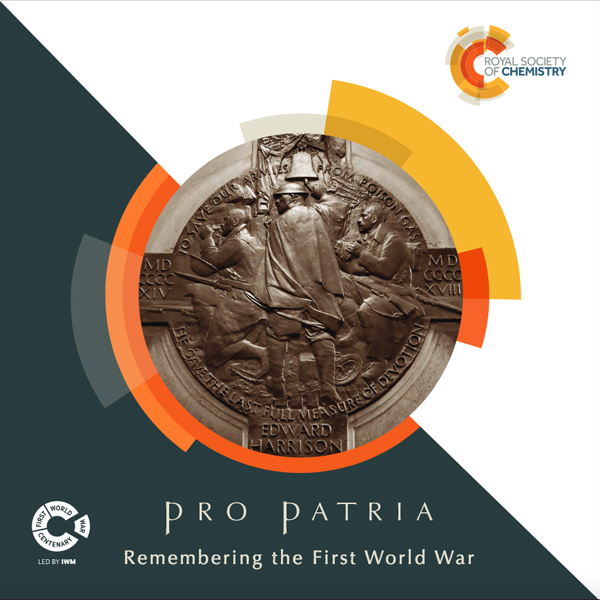 To commemorate the centenary of the First World War (1914-1919), this booklet profiles each of the 82 members of the Chemical Society and the Institute of Chemistry who died on active duty and who are named on the two war memorials within Burlington House. Additionally, there are sections on some of those members who survived the conflict, and the role of women chemists.
The Historical Collection
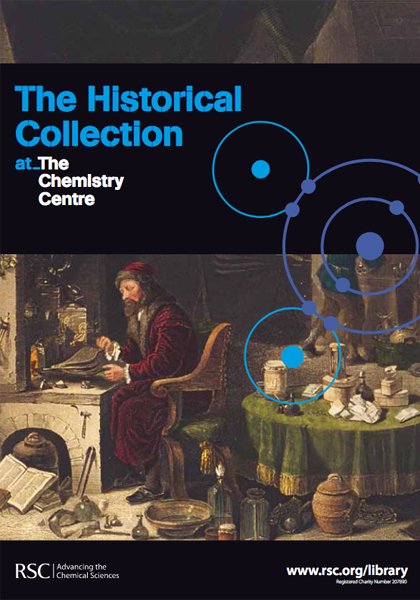 The Library cares for an extensive collection of items on the chemical sciences, part of which is the Historical Collection. This booklet describes each of the component parts of that collection and showcases some of the more notable and unique items within it.
You can find us at
Burlington House
Piccadilly
London
W1J 0BA
Tel: +44 (0) 20 7440 3373
Use the form below for enquiries about:
- Access to, or information about, the collections
- The Historical Collection
- Biographical & genealogical enquiries
- Borrowing books
- Donating books
We aim to respond within two working days.
Share
Spotlight