


You can find details about how to access information remotely in this step-by-step guide. The guide will also help if for any reason you have difficulty accessing the content you want.
What would you like to know about this journal?
Biomaterials Science is a Transformative Journal, and Plan S compliant
Impact factor: 6.6*
Time to first decision (all decisions): 12.0 days**
Time to first decision (peer reviewed only): 38.0 days***
CiteScore: 10.9****
Editor-in-Chief: Jianjun Cheng
Indexed in MEDLINE
Open access publishing options available
Celebrating 10 years of Biomaterials Science
Biomaterials Science Editor-in-Chief Jianjun Cheng celebrates the journal’s 10th anniversary.
Journal scope
Biomaterials Science is an international high impact journal exploring the science of biomaterials and their translation towards clinical use. Its scope encompasses new concepts in biomaterials design, studies into the interaction of biomaterials with the body, and the use of materials to answer fundamental biological questions.
Papers do not necessarily need to report a new biomaterial but should provide novel insight into the biological applications of the biomaterial. Articles that primarily focus on demonstrating novel materials chemistry and bring a molecular picture to bear on a given material’s suitability as a biomaterial are more suited to our companion journal, Journal of Materials Chemistry B.
Biomaterials Science publishes primary research and review-type articles in the following areas:
- molecular design of biomaterials, including translation of emerging chemistries to biomaterials
- science of cells and materials at the nanoscale and microscale
- materials as model systems for stem cell and human biology
- materials for tissue engineering and regenerative medicine
- (Nano)materials and (nano)systems for therapeutic delivery
- interactions at the biointerface
- biologically inspired and biomimetic materials, including bio-inspired self-assembly systems and cell-inspired synthetic tools
- next-generation biomaterials tools and methods
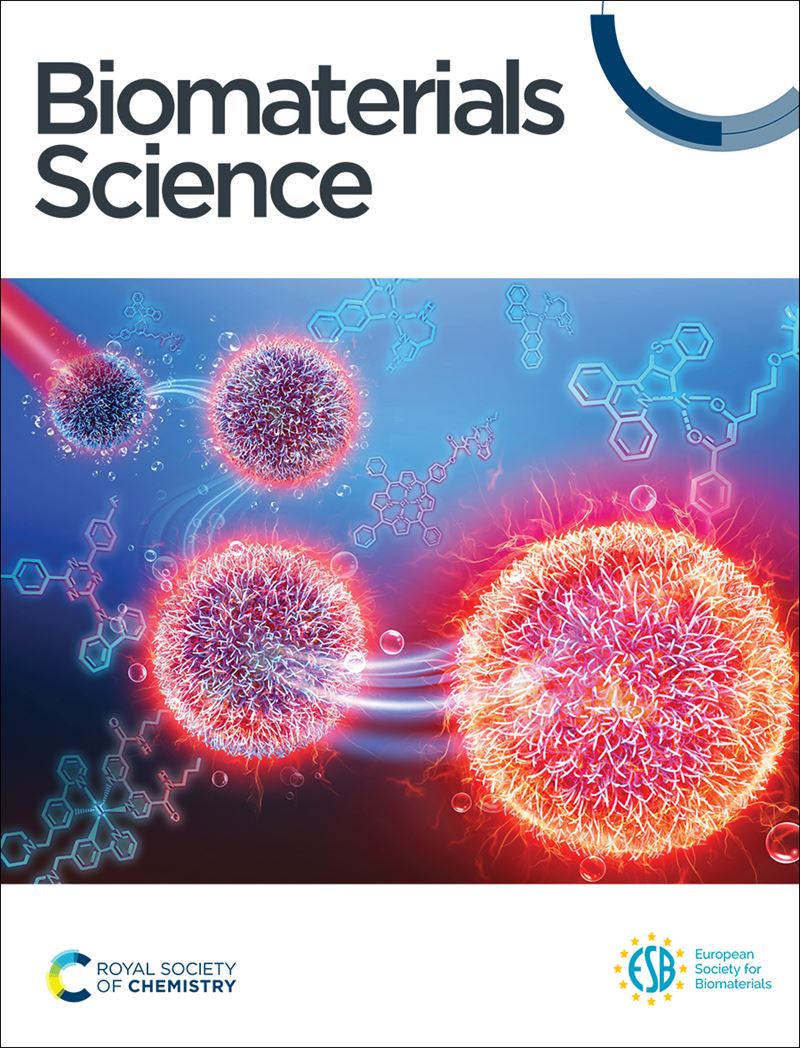
Official journal of the European Society for Biomaterials

Biomaterials Science Lectureship
This annually presented Lectureship recognises early career researchers, within 12 years of their PhD, who have made a significant contribution to the field of biomaterials.
Nominations are welcome from anyone and the winner is then selected by the Biomaterials Science Editorial Board.
Find out more about eligibility, how to nominate, nomination deadlines, and see all the winners of this award.
Meet the team
Find out who is on the editorial and advisory boards for the Biomaterials Science journal.
Editor-in-Chief
Jianjun Cheng, Westlake University, China
Associate editors
Khuloud Al-Jamal, King’s College London, UK
Nasim Annabi, University of California, Los Angeles, USA
Lino Ferreira, UC-Biotech, Portugal
Jöns Hilborn, Uppsala University, Sweden
Won Jong Kim, Pohang University of Science and Technology, Korea
Shyni Varghese, Duke University, USA
Fujian Xu, Beijing University of Chemical Technology, China
Lichen Yin, Soochow University, China
Chuan Zhang, Shanghai Jiao Tong University, China
Editorial board members
Pamela Habibović, Maastricht University, The Netherlands
Xinyuan Zhu, Shanghai Jiao Tong University, China
Kazunari Akiyoshi, Kyoto University, Japan
Cameron Alexander, University of Nottingham, UK
Edmondo Benetti, University of Padova, Italy
Mark Bradley, University of Edinburgh, UK
Jayanta Chatterjee, Indian Institute of Science, India
Arabinda Chaudhuri, Indian Institute of Science Education and Research Kolkata, India
Guoping Chen, National Institute for Materials Science (NIMS), Japan
Yiyun Cheng, East China Normal University, China
Joel Collier, Duke University, USA
Justin Cooper-White, University of Queensland, Australia
Honggang Cui, Johns Hopkins University, USA
Jianwu Dai, Institute of Genetics and Developmental Biology of CAS, China
Cole DeForest, University of Washington, USA
Andrew Dove, University of Birmingham, UK
Yizhou Dong, The Ohio State University, USA
Hongwei Duan, Nanyang Technological University, Singapore
Christine Dufès, University of Strathclyde, UK
Nicholas Dunne, Dublin City University, Ireland
Jennifer Elisseeff, Johns Hopkins University, USA
Shaoqin Sarah Gong, University of Wisconsin-Madison, USA
Dong Keun Han, Cha University, Korea
Ngan Huang, Stanford, USA
Chris Jewell, University of Maryland, USA
Ji Jian, Zhejiang University, China
Ali Khademhosseini, Terasaki Institute for Biomedical Innovation, USA
April Kloxin, University of Delaware, USA
Christine Le Maitre, University of Sheffield, UK
Haeshin Lee, KAIST, Republic of Korea
Khoon Lim, University of Sydney, Australia
Matthias Lutolf, École Polytechnique Fédérale de Lausanne, Switzerland
Atsushi Maruyama, Tokyo Institute of Technology, Japan
Phillip Messersmith, University of California, Berkeley, USA
Aline Miller, University of Manchester, UK
Hyejung Mok, Konkuk University, Korea
Steve Oh, A*STAR, Singapore
Shaunak Pandya, Prolong Pharmaceuticals, USA
Ling Peng, Aix-Marseille University, France
Nicholas Peppas, University of Texas at Austin, USA
Catherine Picart, Grenoble INP, France
Tilo Pompe, University of Leipzig, Germany
Amirali Popat, University of Queensland, Australia
Suzie Pun, University of Washington, USA
Shun Shen, Tongji University, China
Molly Shoichet, University of Toronto, Canada
Xintao Shuai, Sun Yat-Sen University, China
Aasheesh Srivastava, Indian Institute of Science Education and Research, India
Patrick Stayton, University of Washington, USA
Marcus Textor, ETH Zurich, Switzerland
Takafumi Ueno, Tokyo Institute of Technology, Japan
Jun Wang, South China University of Technology, China
Tanja Weil, Max Planck Institute for Polymer Research, Germany
Stephanie Willerth, University of Victoria, Canada
Zimei Wu, The University of Auckland, New Zealand
Evelyn Yim, Waterloo, Canada
Can Zhang, China Pharmaceutical University, China
Maria Southall, Executive Editor, Journals, ORCID 0000-0002-7935-6231
Laura Ghandhi, Deputy Editor, Journals
Cara Sutton, Editorial Production Manager, Journals
Sean Browner, Assistant Editor, Journals
Molly Colgate, Assistant Editor, Journals
Paul Scott, Assistant Editor, Journals
Alison Winder, Assistant Editor, Journals
Basita Javeed, Editorial Assistant, Journals
Allison Holloway, Publishing Assistant, Journals
Sam Keltie, Publisher, Journals, ORCID 0000-0002-9369-8414
Journal guidelines
There are no specific requirements regarding formatting of submissions; we recommend using the Royal Society of Chemistry template but this is not a requirement for submission. All articles accepted for publication in our journals are edited and typeset to our house style by professional editors; we will format the final publication for you.
For guidance on preparing your article please visit our Prepare your article, Resources for authors and Experimental data guidelines pages, the content of which is relevant to all of our journals. Please note the updated guidelines for electrophoretic gels and blots.
Open access publishing options
Biomaterials Science is a hybrid (transformative) journal and gives authors the choice of publishing their research either via the traditional subscription-based model or instead by choosing our gold open access option. Find out more about our Transformative Journals. which are Plan S compliant.
Gold open access
For authors who want to publish their article gold open access, Biomaterials Science charges an article processing charge (APC) of £2,750 (+ any applicable tax). Our APC is all-inclusive and makes your article freely available online immediately, permanently, and includes your choice of Creative Commons licence (CC BY or CC BY-NC) at no extra cost. It is not a submission charge, so you only pay if your article is accepted for publication.
Learn more about publishing open access.
Read & Publish
If your institution has a Read & Publish agreement in place with the Royal Society of Chemistry, APCs for gold open access publishing in Biomaterials Science may already be covered.
Use our journal finder to check if your institution has an open access agreement with us.
Please use your official institutional email address to submit your manuscript and check you are assigned as the corresponding author; this helps us to identify if you are eligible for Read & Publish or other APC discounts.
Traditional subscription model
Authors can also publish in Biomaterials Science via the traditional subscription model without needing to pay an APC. Articles published via this route are available to institutions and individuals who subscribe to the journal. Our standard licence allows you to make the accepted manuscript of your article freely available after a 12-month embargo period. This is known as the green route to open access.
Subscription Information
Online only 2024: ISSN 2047-4849, £2,646 / $4,491
*2022 Journal Citation Reports (Clarivate Analytics, 2023)
**The median time from submission to first decision including manuscripts rejected without peer review from the previous calendar year
***The median time from submission to first decision for peer-reviewed manuscripts from the previous calendar year
****CiteScore™ 2022 available at www.scopus.com/sources
Biomaterials Science
- Email:
- Send us an email
- Email:
- Send us an email
Share
Advertisement