


You can find details about how to access information remotely in this step-by-step guide. The guide will also help if for any reason you have difficulty accessing the content you want.
What would you like to know about this journal?
Polymer Chemistry is a Transformative Journal and Plan S compliant
Impact factor: 4.6*
Time to first decision (all decisions): 14.0 days**
Time to first decision (peer reviewed only): 28.0 days***
CiteScore: 8.6****
Editor-in-Chief: Christopher Barner-Kowollik
Open access publishing options available
Scope
Polymer Chemistry welcomes submissions in all areas of polymer science that have a strong focus on macromolecular chemistry. Manuscripts may cover a broad range of fields, yet no direct application focus is required.
Manuscripts with a strong application focus might be more suitable for our companion journal RSC Applied Polymers.
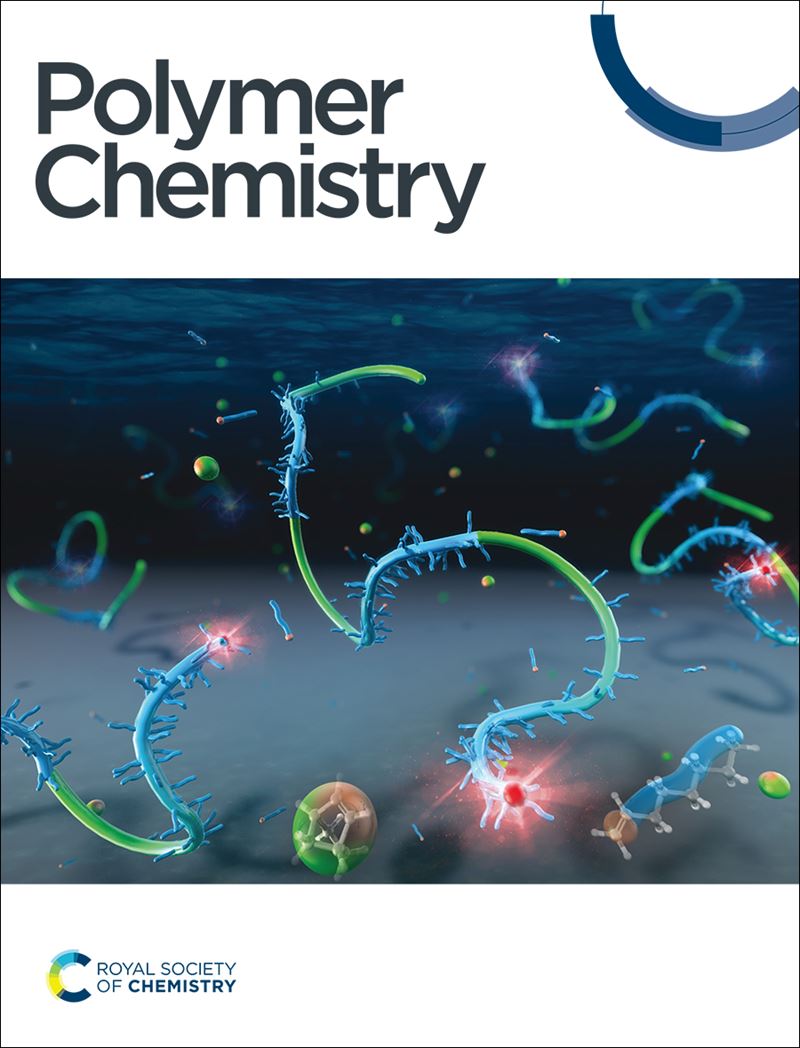
Polymer Chemistry: Editors talk about the journal
Polymer Chemistry Editors discuss their aspirations for the journal, what they are looking for in a paper, and how they approach the peer-review process.
Polymer Chemistry Lectureship
Nominations for this lectureship are now closed.
This Lectureship recognises early career researchers, typically within twelve years of attaining their PhD or equivalent degree, who have made significant contributions to the field of polymer chemistry in their independent academic career.
Find out more about eligibility, how to nominate, nomination deadlines, and see all the winners of this award.
Meet the team
Find out who is on the editorial and advisory boards for the Polymer Chemistry journal.
Editor-in-chief
Christopher Barner-Kowollik, Queensland University of Technology, Australia
Associate editors
Athina Anastasaki, ETH Zurich, Switzerland
Filip Du Prez, Ghent University, Belgium
Holger Frey, Johannes Gutenberg University Mainz, Germany
Rongrong Hu, South China University of Technology, China
Tanja Junkers, Monash University, Australia
Rebekka Klausen, Johns Hopkins University, USA
Dominik Konkolewicz, Miami University, USA
Zhibo Li, Qingdao University of Science and Technology, China
Zi-Chen Li, Peking University, China
Emily Pentzer, Texas A&M University, USA
Steven Armes, University of Sheffield, UK
Remzi Becer, University of Warwick, UK
Matthew Becker, Duke University, USA
Erik Berda, University of New Hampshire, USA
Kerstin Blank, Max Planck Institute of Colloids and Interfaces, Germany
Eva Blasco, Heidelberg University, Germany
James Blinco, Queensland University of Technology, Australia
Chris Bowman, University of Colorado, USA
Cyrille Boyer, University of New South Wales, Australia
Neil Cameron, Monash University, Australia
Luis Campos, Columbia University, USA
Changle Chen, University of Science & Technology of China, China
Mao Chen, Fudan University, China
Xuesi Chen, Chinese Academy of Sciences, China
Yoshiki Chujo, Kyoto University, Japan
Franck D'Agosto, CNRS-University of Lyon, France
Priyadarsi De, Indian Institute of Science Education and Research Kolkata, India
Guillaume Delaittre, University of Wuppertal, Germany
Dagmar D'hooge, University of Ghent, Belgium
Elizabeth Elacqua, Pennsylvania State University, USA
Brett P Fors, Cornell University, USA
Theoni Georgiou, Imperial College London, UK
Didier Gigmes, Aix-Marseilles Université, CNRS, France
Atsushi Goto, Nanyang Technological University, Singapore
Sophie Guillaume, Institut des Sciences Chimiques de Rennes, France
Dave Haddleton, University of Warwick, UK
Nikos Hadjichristidis, King Abdullah University of Science and Technology, Saudi Arabia
Yanchun Han, Chinese Academy of Sciences, China
Simon Harrisson, CNRS, University of Toulouse, France
Eva Marie Harth, University of Houston, USA
Laura Hartmann, Heinrich Heine University Düsseldorf, Germany
Fiona Hatton, Loughborough University, UK
Andrew B Holmes, University of Melbourne, Australia
Richard Hoogenboom, University of Ghent, Belgium
Steve Howdle, University of Nottingham, UK
Feihe Huang, Zheijiang University, China
Jeremiah A Johnson, Massachusetts Institute of Technology, USA
Toyoji Kakuchi, Changchun University of Science and Technology, China
Julia Kalow, Northwestern University, USA
Masami Kamigaito, Nagoya University, Japan
Justin Kennemur, Florida State University, USA
Christopher Kloxin, University of Delaware, USA
Jacques Lalevée, Institut de Science des Matériaux de Mulhouse, France
Katharina Landfester, Max Planck Institute, Germany
Muriel Lansalot, Université Lyon, France
Sebastien Lecommandoux, ENSCPB, University of Bordeaux, France
Rachel A. Letteri, University of Virginia, USA
Guey-Sheng Liou, National Taiwan University, Taiwan
Guoliang Liu, Virginia Tech, USA
Shiyong Liu, University of Science & Technology, China
Timothy Long, Arizona State University, USA
Christine K Luscombe, Okinawa Institute of Science and Technology, Japan
John Matson, Virginia Tech, USA
Markus Muellner, University of Sydney, Australia
Ravin Narain, University of Alberta, Canada
Julien Nicolas, University Paris-Sud, France
Kyoko Nozaki, University of Tokyo, Japan
Rachel O'Reilly, University of Warwick, UK
Makoto Ouchi, Kyoto University, Japan
Derek Patton, University of Southern Mississippi, USA
Seb Perrier, University of Warwick, UK
Theresa Reineke, University of Minnesota, USA
Megan Robertson, University of Houston, USA
Amitav Sanyal, Bogazici University, Turkey
Felix Schacher, Friedrich-Schiller-University Jena, Germany
Helmut Schlaad, University of Potsdam, Germany
Ellen Sletten, University of California, Los Angeles, USA
Martina Stenzel, University of New South Wales, Australia
Molly Stevens, Imperial College London, UK
Nathalie Stingelin, Georgia Institute of Technology, USA
Ben Zhong Tang, HKUST, Hong Kong, China
Lei Tao, Tsinghua University, China
Patrick Theato, KIT, Germany
Maria Vamvakaki, FORTH-IESL, Greece
Jan van Hest, Eindhoven University of Technology, The Netherlands
Kelly Velonia, University of Crete, Greece
María J. Vicent, CIPF, Spain
Brigitte Voit, Leibniz Institute of Polymer Research, Germany
Marcus Weck, NYU, USA
Charlotte Williams, University of Oxford, UK
Frederik Wurm, Max-Planck-Institut für Polymerforschung, Germany
Naoko Yoshie, University of Tokyo, Japan
Wei You, University of North Carolina at Chapel Hill, USA
Xi Zhang, Tsinghua University, China
Maria Southall, Executive Editor, Journals, ORCID 0000-0002-7935-6231
Laura Ghandhi, Deputy Editor, Journals
Cara Sutton, Editorial Production Manager, Journals
Sean Browner, Assistant Editor, Journals
Molly Colgate, Assistant Editor, Journals
Paul Scott, Assistant Editor, Journals
Alison Winder, Assistant Editor, Journals
Basita Javeed, Editorial Assistant, Journals
Allison Holloway, Publishing Assistant, Journals
Sam Keltie, Publisher, Journals, ORCID 0000-0002-9369-8414
Journal specific guidelines
There are no specific requirements regarding formatting of submissions; we recommend using the Royal Society of Chemistry template but this is not a requirement for submission. All articles accepted for publication in our journals are edited and typeset to our house style by professional editors; we will format the final publication for you.
Characterisation guidelines
In addition to the general guidelines, authors are asked to provide the following data for the characterisation of polymers:
Analytical
For all soluble polymers an estimation of molecular weight must be provided by a suitable method. For example, size exclusion chromatography, including details of columns, eluents and calibration standards, intrinsic viscosity, MALDI TOF, etc.
For insoluble and crosslinked polymers, elemental analysis (within ±0.4% of the calculated value) is required to confirm sample purity and composition. For optoelectronic compounds, UV-visible data should be reported.
Physical
Important physical properties, such as Tg and Tm, should be included where appropriate.
Spectroscopic
For all soluble polymers full NMR characterisation (1H,13C) in support of the assigned structure, including relevant 2D NMR and related experiments (that is, NOE, etc) is required. Authors are encouraged to provide copies of these spectra in the electronic supplementary information (ESI).
For all polymers Infrared spectra that support functional group modifications, including other diagnostic assignments should be included.
Terminology
For information on the IUPAC recommendations for polymer nomenclature please see A Brief Guide to Polymer Nomenclature (PDF).
Open access publishing options
Polymer Chemistry is a hybrid (transformative) journal and gives authors the choice of publishing their research either via the traditional subscription-based model or instead by choosing our gold open access option. Find out more about our Transformative Journals. which are Plan S compliant.
Gold open access
For authors who want to publish their article gold open access, Polymer Chemistry charges an article processing charge (APC) of £2,750 (+ any applicable tax). Our APC is all-inclusive and makes your article freely available online immediately, and permanently, and includes your choice of Creative Commons licence (CC BY or CC BY-NC) at no extra cost. It is not a submission charge, so you only pay if your article is accepted for publication.
Learn more about publishing open access.
Read & Publish
If your institution has a Read & Publish agreement in place with the Royal Society of Chemistry, APCs for gold open access publishing in Polymer Chemistry may already be covered.
Use our journal finder to check if your institution has an open access agreement with us.
Please use your official institutional email address to submit your manuscript and check you are assigned as the corresponding author; this helps us to identify if you are eligible for Read & Publish or other APC discounts.
Traditional subscription model
Authors can also publish in Polymer Chemistry via the traditional subscription model without needing to pay an APC. Articles published via this route are available to institutions and individuals who subscribe to the journal. Our standard licence allows you to make the accepted manuscript of your article freely available after a 12-month embargo period. This is known as the green route to open access.
Readership information
Polymer chemists in industry and academia, plus materials scientists and bioscientists.
Subscription information
Polymer Chemistry is part of RSC Gold and Materials Science subscription packages.
Online only 2024: ISSN 1759-9962, £3,052 / $5,214
*2022 Journal Citation Reports (Clarivate Analytics, 2023)
**The median time from submission to first decision including manuscripts rejected without peer review from the previous calendar year
***The median time from submission to first decision for peer-reviewed manuscripts from the previous calendar year
****CiteScore™ 2022 available at www.scopus.com/sources
Polymer Chemistry
- Email:
- Send us an email
- Email:
- Send us an email
Share
Advertisement