
You can find details about how to access information remotely in this step-by-step guide. The guide will also help if for any reason you have difficulty accessing the content you want.
What would you like to know about this journal?
Impact factor: 3.3*
Time to first decision (all decisions): 17.0 days**
Time to first decision (peer reviewed only): 27.0 days***
Editor-in-chief: Jean-François Gérard
Indexed in Web of Science and Scopus
Open access publishing options available
Journal scope
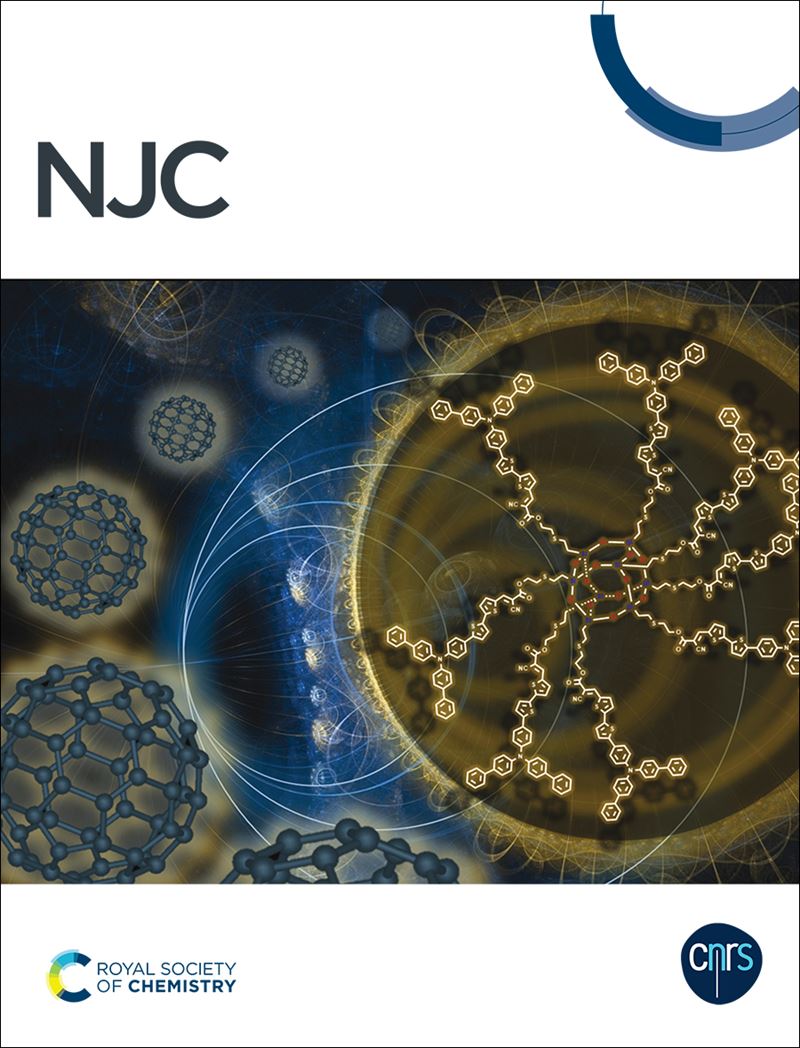
NJC (New Journal of Chemistry) is a broad-based primary journal encompassing all branches of chemistry and its sub-disciplines. It contains full research articles, communications, perspectives and focus articles.
This well-established journal, owned by the Centre National de la Recherche Scientifique (CNRS) of France, has been co-published with the Royal Society of Chemistry since January 1998.
NJC is the forum for the publication of high-quality, original and significant work that opens new directions in chemistry or other scientific disciplines.
In addition to having a significant chemical component, work published in NJC must demonstrate that it will have an impact on areas of research other than that of the reported work.
Meet the team
Find out who is on the editorial and advisory boards for the New Journal of Chemistry, and who is in the editorial office.
Editor-in-Chief
Jean-François Gérard, INSA Lyon, University of Lyon, France
Associate editors
Yutaka Amao, Graduate School of Science Osaka Metropolitan University, Japan
Annie Castonguay, INRS (University of Quebec), Canada
Alexander J. Andre Cobb, King’s College London
Vera R. L. Constantino, University of São Paulo, Brazil
Catharine Esterhuysen, University of Stellenbosch, South Africa
David Farrusseng, IRCELYON-CNRS, France
Yannick Guari, University of Montpellier, France
Peter Junk, James Cook University, Australia
Hee-Je Kim, Pusan National University, Republic of Korea
Venkata Krishnan, School of Chemical Sciences, Indian Institute of Technology Mandi, India
Dai-Wen Pang, Nankai University, China
Karine Philippot, Laboratory of Coordination Chemistry, France
Luca Prodi, University of Bologna, Italy
Maarten Roeffaers, Katholieke Universiteit Leuven, Belgium
Edina Rosta, University College London, UK
Akhila K. Sahoo, University of Hyderabad, India
Jianji Wang, Henan Normal University, China
Gregory Welch, University of Calgary, Canada
Kazunari Yoshizawa, Kyoto University, Japan
Jinghua Yu, University of Jinan, China
Editorial board members
Debbie Crans, Colorado State University, USA
Members
Odile Eisenstein, Consulting Editor, Universite Montpellier 2, France
David Aitken, Universite Paris-Sud, France
Martyn Coles, Victoria University, New Zealand
Qiang Cui, Boston University, USA
Marijana Đaković, University of Zagreb, Croatia
Parthasarathi Das, Indian Institute of Technology (ISM) Dhanbad, India
Pablo Andres Denis, Universidad de la República Facultad de Química, Uruguay
R. Dario Falcone, Consejo Nacional de Investigaciones Científicas y Técnicas, Argentina
Dinorah Gambino, University of the Republic (Uruguay), Uruguay
Yulia G. Gorbunova, Russian Academy of Sciences, Russia
Barnaby Greenland, University of Sussex, UK
Delia Haynes, Stellenbosch University, South Africa
Hendrik Heinz, University of Colorado Boulder, USA
Mir Wais Hosseini, Universite de Strasbourg, France
Takashi Kato, University of Tokyo, Japan
Vladimir V. Kouznetsov, Universidad Industrial de Santander, Colombia
Eder Joao Lenardao, Universidade Federal de Pelotas, Brazil
Benoit Lessard, University of Ottawa, Canada
Mi Hee Lim, KAIST, Korea
Paul Low, University of Western Australia, Australia
Jean-Pierre Majoral, University of Toulouse, France
Tebello Nyokong, Rhodes University, South Africa
David Reinhoudt, Universitry of Twente, The Netherlands
Marie-Cristine Scherrmann, Université Paris-Saclay, France
Jonathan Steed, Durham University, UK
Consiglia Tedesco, University of Salerno, Italy
William Tiznado, Universidad Andres Bello, Chile
Hai-Yan Xie, Beijing Institute of Technology, China
Lin Xu, East China Normal University, China
Yi-Jun Xu, Fuzhou University, China
Vivian Yam, Hong Kong University, Hong Kong
Edwin Yeow, Nanyang Technological University, Singapore
Davit Zargarian, University of Montreal, Canada
Yuming Zhao, Memorial University of Newfoundland, Canada
Sally Howells-Wyllie, Executive Editor
Mike Andrews, Deputy Editor, ORCID 0000-0003-3762-8523
Michelle Canning, Development Editor
Emily Cuffin-Munday, Development Editor
Daphne Houston, Editorial Assistant
Eva Balentova, Assistant Editor
Lilybelle Wyatt, Editorial Production Manager
Debora Giovanelli, Publishing Editor
Helen Lunn, Publishing Editor
Samuel Oldknow, Publishing Editor
Kate Tustain, Publishing Editor
Huw Hedges, Publishing Assistant
Jeanne Andres, Publisher
Readership information
New Journal of Chemistry is for academic and industrial scientists in all areas of the chemical sciences.
Open access publishing options
NJC is a hybrid journal and gives authors the choice of publishing their research either via the traditional subscription-based model or instead by choosing our gold open access option.
Gold open access
For authors who want to publish their article gold open access, NJC charges an article processing charge (APC) of £2,750 (+ any applicable tax). Our APC is all-inclusive and makes your article freely available online immediately, permanently, and includes your choice of Creative Commons licence (CC BY or CC BY-NC) at no extra cost. It is not a submission charge, so you only pay if your article is accepted for publication.
Learn more about publishing open access.
Read & Publish
If your institution has a Read & Publish agreement in place with the Royal Society of Chemistry, APCs for gold open access publishing in NJC may already be covered.
Use our journal finder to check if your institution has an open access agreement with us.
Please use your official institutional email address to submit your manuscript and check you are assigned as the corresponding author; this helps us to identify if you are eligible for Read & Publish or other APC discounts.
Traditional subscription model
Authors can also publish in NJC via the traditional subscription model without needing to pay an APC. Articles published via this route are available to institutions and individuals who subscribe to the journal. Our standard licence allows you to make the accepted manuscript of your article freely available after a 12-month embargo period. This is known as the green route to open access.
Subscription information
New Journal of Chemistry is part of RSC Gold, Core Chemistry and General Chemistry subscription packages.
Online only 2024: ISSN 1369-9261 £2,491 / $4,191
*2022 Journal Citation Reports (Clarivate Analytics, 2023)
**The median time from submission to first decision including manuscripts rejected without peer review from the previous calendar year
***The median time from submission to first decision for peer-reviewed manuscripts from the previous calendar year
NJC
- Email:
- Send us an email
- Email:
- Send us an email
Share
Advertisement