


You can find details about how to access information remotely in this step-by-step guide. The guide will also help if for any reason you have difficulty accessing the content you want.
What would you like to know about this journal?
Impact factor: 2.6*
Time to first decision (all decisions): 21.0 days**
Time to first decision (peer reviewed only): 26.0 days***
Editors-in-Chief: Christian Doonan and C. Malla Reddy
Indexed in Web of Science and Scopus
Open access publishing options available
Journal scope
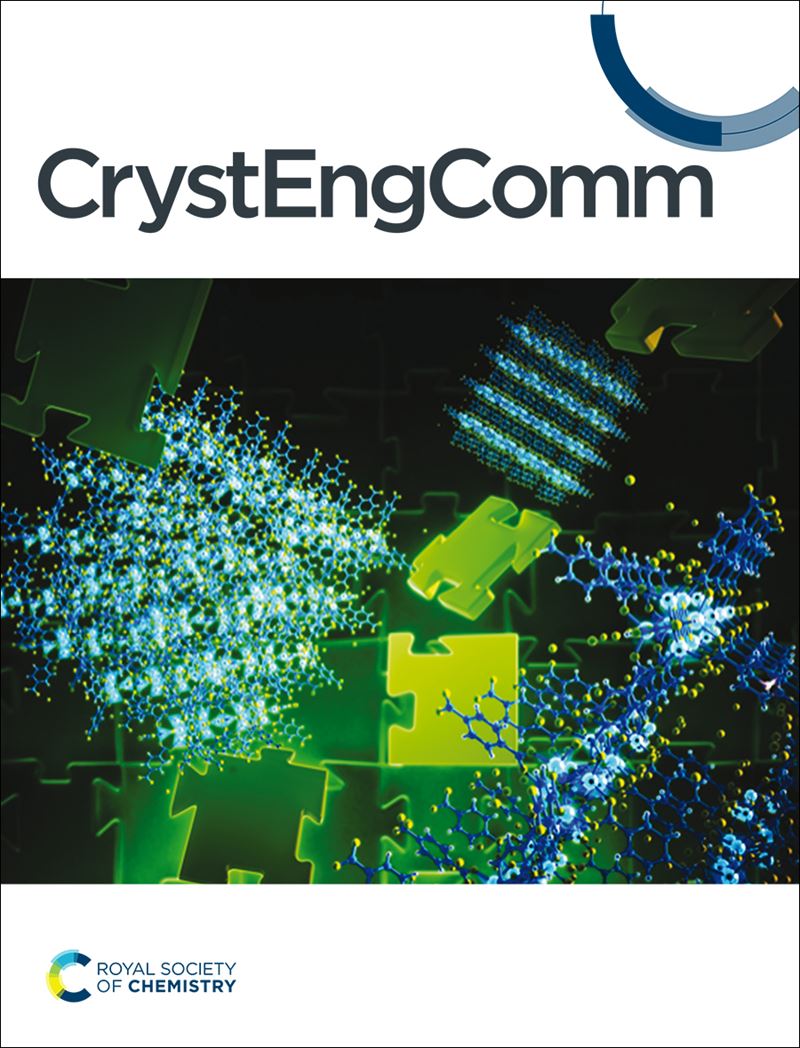
CrystEngComm is the forum for the design and understanding of crystalline materials. We welcome studies on the investigation of molecular behaviour within crystals, control of nucleation and crystal growth, engineering of crystal structures, and construction of crystalline materials with tuneable properties and functions.
We publish hypothesis-driven research into…
how crystal design affects thermodynamics, phase transitional behaviours, polymorphism, morphology control, solid state reactivity (crystal-crystal solution-crystal, and gas-crystal reactions), optoelectronics, ferroelectric materials, non-linear optics, molecular and bulk magnetism, conductivity and quantum computing, catalysis, absorption and desorption, and mechanical properties.
Using Techniques and methods including…
Single crystal and powder X-ray, electron, and neutron diffraction, solid-state spectroscopy, spectrometry, and microscopy, modelling and data mining, and empirical, semi-empirical and ab-initio theoretical evaluations.
On crystalline and solid-state materials.
We particularly welcome work on MOFs, coordination polymers, nanocrystals, host-guest and multi-component molecular materials. We also accept work on peptides and liquid crystals.
All papers should involve the use or development of a design or optimisation strategy. Routine structural reports or crystal morphology descriptions, even when combined with an analysis of properties or potential applications, are generally considered to be outside the scope of the journal and are unlikely to be accepted.
Meet the team
Find out who is on the editorial and advisory boards for the CrystEngComm journal.
Editors-in-Chief
Christian Doonan, The University of Adelaide, Australia
C. Malla Reddy, Indian Institute of Technology, Hyderabad, India
Associate editors
Susan Bourne, University of Cape Town, South Africa
Kwangyeol Lee, Korea University, Korea
Dongfeng Xue, Multiscale Crystal Materials Research Center, Shenzhen Institute of Advanced Technology, CAS, China
Editorial board members
Sharmarke Mohamed, Khalifa University of Science and Technology, UAE
Susan Reutzel-Edens, SuRE Pharma Consulting, LLC, USA
Ghazala Sadiq, The Cambridge Crystallographic Data Centre, UK
Changquan Calvin Sun, University of Minnesota, USA
Bin Zhao, Nankai University, China
Christer Aakeroy, Kansas State University, USA
Srinivasulu Aitipamula, Institute of Sustainability for Chemicals, Energy and Environment, Singapore
Alessia Bacchi, University of Parma, Italy
Elena Boldyreva, Novosibirsk State University, Russia
Andrew Bond, University of Cambridge, UK
Deepak Chopra, IISER Bhopal, India
Jack Clegg, University of Queensland, Australia
Simon Coles, University of Southampton, UK
Franziska Emmerling, Federal Institute for Materials Research and Testing in Berlin, Germany
Paolo Falcaro, TU Graz, Austria
Omar Farha, Northwestern University, USA
Sylvie Ferlay, Institut Le Bel, France
Antonio Frontera, University of the Balearic Islands, Spain
Georg Garnweitner, TU Braunschweig, Germany
David Harding, Suranaree University of Technology, Thailand
Chris Hawes, University of Keele, UK
Delia Haynes, Stellenbosch University, South Africa
Kristin Hutchins, University of Missouri, USA
Christoph Janiak, University of Dusseldorf, Germany
Franca Jones, Curtin University, Australia
Jing Li, Rutgers University, USA
Tong-Bu Lu, Tianjin University of Technology, China
Chiara Maccato, Padova University, Italy
Yuji Matsumoto, Tohoku University, Japan
Abel Moreno, National Autonomous University of Mexico, Mexico
Anja-Verena Mudring, Aarhus University, Denmark
Parthapratim Munshi, Shiv Nadar University, India
Ashwini Nangia, University of Hyderabad, India
Lars Öhrström, Chalmers University of Technology, Sweden
Simon Parsons, University of Edinburgh, UK
Cynthia Pereira, Universidade Federal de Minas Gerais- UFMG, Brazil
Wei-Yin Sun, Nanjing University, China
Jennifer Swift, Georgetown University, USA
Edward R T Tiekink, Universitat de les Illes Balears, Spain
Hongjie Zhang, Changchun Institute of Applied Chemistry, China
Sally Howells-Wyllie, Executive Editor
Mike Andrews, Deputy Editor, ORCID 0000-0003-3762-8523
Michelle Canning, Development Editor
Emily Cuffin-Munday, Development Editor
Susannah Davies, Editorial Manager
Gaia De Angelis, Publishing Editor
Debora Giovanelli, Publishing Editor
Helen Lunn, Publishing Editor
Samuel Oldknow, Publishing Editor
Daphne Houston, Editorial Assistant
Huw Hedges, Publishing Assistant
Sam Keltie, Publisher, ORCID 0000-0002-9369-8414
Journal specific guidelines
All submissions to CrystEngComm must include a file of the “integrated manuscript”: this is a file with all of the tables and artwork integrated into the text at a point close to where the table/figure/scheme, etc., is first mentioned.
- Tables should be complete with the table number and title above the table and footnotes below. Please place the table in the text at a point where the entire table can fit on a single page (unless the table is longer than a single page).
- Figures/schemes/charts should have the number and caption below the artwork. Avoid splitting the graphic over two pages (when possible) by placing it appropriately in the text.
To avoid the shifting of inserted graphics/tables during the generation of the pdf file that is read by the editors and reviewers, authors are encouraged to upload a pdf version of their “integrated manuscript” in addition to the native file.
For articles which describe the synthesis or applications of crystals on the nano- or micro-scale, authors should only use descriptive terms that are widely accepted in the literature (e.g. nanocrystal, nanostructure, nanoparticle, nanowire, nanotube, nanosphere, nanorod), to aid article discoverability. In addition, morphology descriptors such as 'flower-like' and other similar terms should not be included in the article title.
Transparent peer review
As part of our commitment to transparency and open science, CrystEngComm is now offering authors the option of transparent peer review, where the editor’s decision letter, reviewers’ comments and authors’ response for all versions of the manuscript will be published alongside the article under an Open Access Creative Commons licence (CC-BY).
Reviewers will remain anonymous unless they choose to sign their report.
Open access publishing options
CrystEngComm is a hybrid journal and gives authors the choice of publishing their research either via the traditional subscription-based model or instead by choosing our gold open access option.
Gold open access
For authors who want to publish their article gold open access, CrystEngComm charges an article processing charge (APC) of £3,000 (+ any applicable tax). Our APC is all-inclusive and makes your article freely available online immediately, permanently, and includes your choice of Creative Commons licence (CC BY or CC BY-NC) at no extra cost. It is not a submission charge, so you only pay if your article is accepted for publication.
Learn more about publishing open access.
Open access agreements
If your institution has an RSC open access agreement or APCs for gold open access, publishing in this journal may already be covered.
Use our journal finder to check if your institution has an open access agreement with us.
Please use your official institutional email address to submit your manuscript and check you are assigned as the corresponding author; this helps us to identify if you are eligible under an open access agreement or other APC discounts.
Traditional subscription model
Authors can also publish in CrystEngComm via the traditional subscription model without needing to pay an APC. Articles published via this route are available to institutions and individuals who subscribe to the journal. Our standard licence allows you to make the accepted manuscript of your article freely available after a 12-month embargo period. This is known as the green route to open access.
Readership information
Researchers in industry and academia working in the following fields.
- Solid-state inorganic and organic chemistry
- Materials chemistry
- Crystallography
- Crystal growth
- Crystal engineering
Subscription information
CrystEngComm is part of RSC Gold and Materials Science subscription packages
Online only 2025: ISSN 1466-8033 £1,457 / $2,163
*2023 Journal Citation Reports (Clarivate Analytics, 2024)
**The median time from submission to first decision including manuscripts rejected without peer review from the previous calendar year
***The median time from submission to first decision for peer-reviewed manuscripts from the previous calendar year
CrystEngComm
- Email:
- Send us an email
- Email:
- Send us an email
Share
Advertisement