
The BoostCrop team
Prize
Faraday Horizon PrizesYear
2025
Citation
For the development of a library of biocompatible molecules that can on application harness solar UV energy and enhance crop growth.
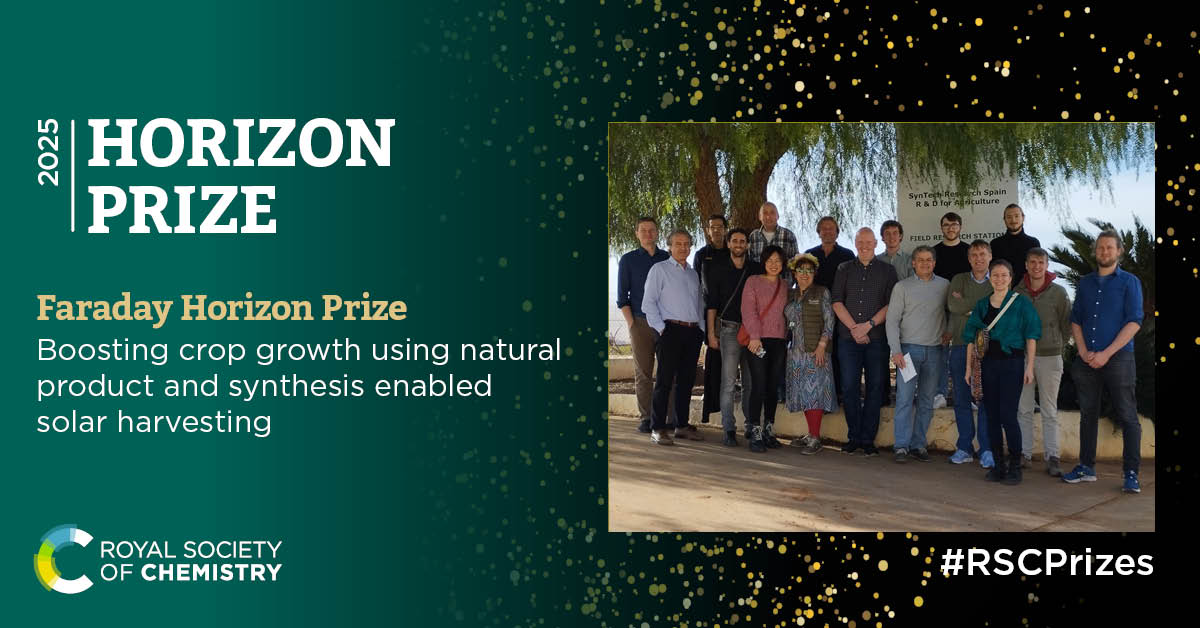

The BoostCrop team have pioneered the development of a library of biocompatible molecules that harness solar ultraviolet (UV) radiation. These molecules are applied onto plants as a water-based foliar spray. They then absorb UV radiation, convert this to heat and provide the crop with supplementary heat thereby encouraging successful crop growth in cooler geographical regions and helping mitigate against sudden daytime frost damage.
Ensuring future food security in a changing climate requires the development of novel technologies in crop production. The Boostcrop project represents a great example of how international interdisciplinary collaboration can develop innovative new approaches to such challenges.
Professor Kerry Franklin
- Temitope Abiola, Researcher, University of Warwick
- Jimmy Alarcan, Researcher, Bundesinstitut für Risikobewertung
- Florent Allais, Workpackage Lead Investigator, AgroParisTech
- Mike Ashfold, University Lead Investigator, University of Bristol
- Mario Barbatti, Workpackage Lead Investigator, The Aix Marseille University
- Giel Berden, Lead Investigator, The Stichting Katholieke University
- Marisé Borja, Workpackage Lead Investigator, GAB Spain
- Albert Braeuning, Lead Investigator, Bundesinstitut für Risikobewertung
- Wybren Jan Buma, Workpackage Lead Investigator, University of Amsterdam
- Mariana Casal, Researcher, The Aix Marseille University
- Jack Dalton, Researcher, University of Birmingham
- Jiayun Fan, Researcher, University of Amsterdam
- Amandine Flourat, Lead Investigator, AgroParisTech
- Adrian Fowle, Research Support Services, University of Warwick
- Keara Franklin, Workpackage Lead Investigator, University of Bristol
- Ed Greenough, BoostCrop Project Manager, University of Warwick
- Chris Groves, Researcher, University of Bristol
- James Lloyd Hughes, University Lead Investigator, University of Warwick
- Michael Hymas, Researcher, University of Birmingham
- Matthieu Mention, Researcher, AgroParisTech
- Louis Mouterde, Researcher, AgroParisTech
- Teun Munnik, University Lead Investigator, University of Amsterdam
- Tom Oliver, University Lead Investigator, University of Bristol
- Jos Oomens, Workpackage Lead Investigator, The Stichting Katholieke University
- Aurélien Peru, Researcher, AgroParisTech
- Cédric Peyrot, Researcher, AgroParisTech
- Daniel Polak, Researcher, University of Bristol
- Natércia Rodrigues Lopes, Researcher, University of Warwick
- Benjamin Rioux, Researcher, AgroParisTech
- Ivan Romanov, Researcher, University of Amsterdam
- Hans Sanders, Researcher, University of Amsterdam
- Xandra Schrama, Researcher, University of Amsterdam
- Michael Staniforth, Researcher, University of Warwick
- Vasilios Stavros, BoostCrop Coordinator, University of Birmingham
- Josene Toldo, Researcher, The Aix Marseille University
- Matthias Vink, Researcher, The Stichting Katholieke University
- Jack Woolley, Researcher, University of Warwick
2025 Faraday Horizon Prize: The-BoostCrop-Team


Q&A with The BoostCrop team
What were the biggest challenges in this project?
Vasilios Stavros: Candidly speaking, I thought it would be bringing a range of researchers of different backgrounds together and trying to speak the same scientific language but how wrong I was – this was the easy part! Trying to schedule meetings where everyone could join was most challenging given the size of the BoostCrop Team!
What different strengths did different people bring to the team?
Vasilios Stavros: This was truly a multidisciplinary research project bringing together chemists, physicists, biologists, toxicologists and an SME to tackle the common and vital goal in food security. Importantly, everyone had a role to play in the success of BoostCrop, from our amazing early career researchers to our seasoned academic and industry colleagues.
Why is this work so important and exciting?
Vasilios Stavros: Food security is a growing area of concern, with the United Nations listing it as part of their Sustainable Development Initiatives. To improve food security, current harvests must be enhanced. The BoostCrop team proposed the development and application of organic molecular heaters (MHs); photothermal molecules which are incorporated in a water-based foliar spray and applied to crops
The premise is that these MHs absorb ultraviolet (UV) radiation, convert this to heat and provide the crop with supplementary heat thereby encouraging successful crop growth in cooler geographical regions and helping mitigate against sudden daytime frost damage.
To note, frost damage alone is estimated to cost Europe €3.3 billion per annum in reduced harvests. BoostCrop brought together a multidisciplinary team to tackle this very important problem head on. We believe we have made a small but very important contribution to this sustainable development initiative. Importantly, this is a very nice example (I think) where blue-sky research can have a major impact on society.
Where do you see the biggest impact of this technology/research being?
Vasilios Stavros: Certainly in crop protection and food security. That said, our molecular heaters were synthesised using novel green chemistry approaches; approaches which could lend themselves to other areas of synthetic chemistry. Additionally, the theory and computational software used to model the data could be used in other areas of chemistry (and beyond) to interpret molecular processes post absorption of light.
How will this work be used in real life applications?
Vasilios Stavros: To enhance crop growth during daytime frost and encourage crop growth in cooler geographical locations.
How do you see this work developing over the next few years, and what is next for this technology/research?
Vasilios Stavros: Perhaps the biggest (and exciting!!) challenge is upscaling our molecular heater technology. Prior to this, our field trial work that tested the performance of our foliar spray was on a kg scale of molecular heater. We absolutely need to work towards increasing scale (and cheaply) so that this technology can be commercial-ready. The BoostCrop team are currently exploring this through the application of follow on grants.
What inspires or motivates your team?
Vasilios Stavros: People working together towards a common and vital goal. Our early career researchers epitomise the contagious motivation and it was an absolute pleasure working with highly talented PhD students and postdoctoral researchers.
What is the importance of collaboration in the chemical sciences?
Vasilios Stavros: The diversity in skill set a large collaborative team brings together enables researchers to potentially achieve significant impact in a field that pockets of smaller research teams cannot achieve. This is a classical case of the whole is greater than the sum of parts.
Related pages
Join us
Become a member of the Royal Society of Chemistry.
Professional awards
Raise the bar. Gain recognition. Apply for a professional award.
Our winners
We are recognising individuals, collaborations and teams for their exceptional achievements in advancing the chemical sciences. Thank you to everybody who took the time to make a nomination this year, and to all of our volunteers on our judging panels. Explore our prize winners, and discover and share their stories.
Explore prize winners