

Tribute to the courage of Trafalgar women
The courage of three women, possibly prostitutes, who nursed casualties on HMS Victory at the Battle of Trafalgar, experiencing naval warfare at its most brutal, will be commemorated on 19 October when a Limited Edition rum commissioned by the Royal Society of Chemistry is uncorked in London's Isle of Dogs.
The Royal Society of Chemistry's motivation in acknowledging the overlooked role that women played in the horrific conditions of the battle* is to mark the contribution that chemistry has made since 1805 to the aftermath of battle through the development of medicines.
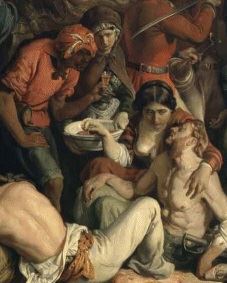
Inspiration for the rum project was a peripheral scene in the epic painting "The Death of Nelson" in which three women are depicted tending a sailor slumped amid carnage of the engagement, while centrally the mortally wounded Admiral Nelson attracts the care of kneeling officers.
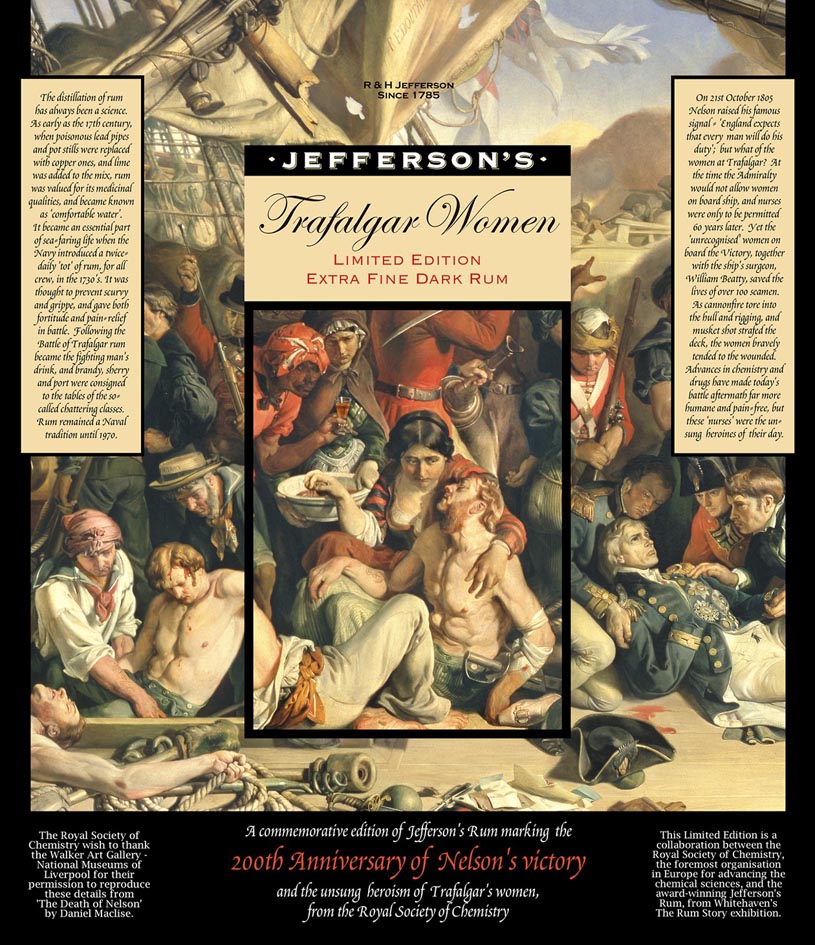
The Royal Society of Chemistry worked with The Rum Story, Whitehaven, to produce the commemorative rum which will come in cylinders illustrating the scene of the women nursing a fallen sailor. The society will send complimentary bottles of Trafalgar Women rum to appropriate individuals and organisations.
The massive painting by Daniel Maclise in the Walker Art Gallery, National Museums, Liverpool, provided the image to feature on the cylinders in which the bottles of Jefferson rum are contained. A 'twin' copy of the painting also resides in the Palace of Westminster where momentous historical episodes from British history are recalled in art.
Drug discovery scientist Dr Simon Campbell, President of the Royal Society of Chemistry - which was founded 36 years after Trafalgar - said today: "We do not know the inspiration for depicting these particular three women but we are confident they played an invaluable nursing role in Nelson's fleet."
He added: "This painting leaves little to the imagination in reflecting the horrifying conditions endured by those in the heat of a full-blooded naval engagement."
Books published this year enter into harrowing detail, enumerating injuries above and below decks, where sailors and marines were speared by shards of timber feet in length, struck by flying heads and limbs of comrades and by raked by broadsides that despatched hot metal like horizontal rain the entire length of decks.
Pitched into this nightmarish scene and sharing its terrors were women who evidently took their chances alongside the crews, caring for the wounded where and when they were able with rudimentary means. In the Maclise painting one woman handles a bowl of water while mopping blood and another proffers a glass, possibly containing rum.
"In this Trafalgar month," said Dr Campbell, "we are making a long-overdue gesture to those brave women. We might never know who they were - although perhaps the artist knew - but their ministrations to the wounded and dying should be recalled with admiration."
Dr Campbell added: "This also gives us an opportunity to reflect on the massive advances that chemistry has allowed in the treatment of injuries and in speeding recovery. We celebrate the research of generations of our profession who have employed their knowledge and skills to relieve suffering."
|
The scene in which the Trafalgar Women worked Surgeons' knives warmed on Nelson's orders as he had experienced the agony of a cold blade. The passage of the enemy cannonballs causing men to fall unblemished, killed by the shock of the projectiles' pressure waves. Grape and cannon shot pouring through port-holes like "leaden rain". Out of the same portholes the dead would have been thrown. Noise growing to a level that people had never before experienced, as ships trembled deep into their frames and keels from the reverberations of their own guns. (Detail taken from Men of Honour: Trafalgar and the Making of the English Hero by Adam Nicolson, Harper Collins 2005) |
Press office
- Tel:
- +44 (0) 20 7440 3351
- Email:
- Send us an email